I was watching a lecture by Italian theoretical physicist and writer Carlo Rovelli, who wrote the amazing book “Seven Brief Lessons on Physics”. He explained why the time we experience in day to day life works fine but it breaks down in we go to space.
Basically, what we think we know about time is wrong.
The crazy part is, Einstein figured this out over 100 years ago, and we’re still catching up. The deeper meaning of time will probably seem obvious to people in the future due to space travel but it’s still blowing minds.
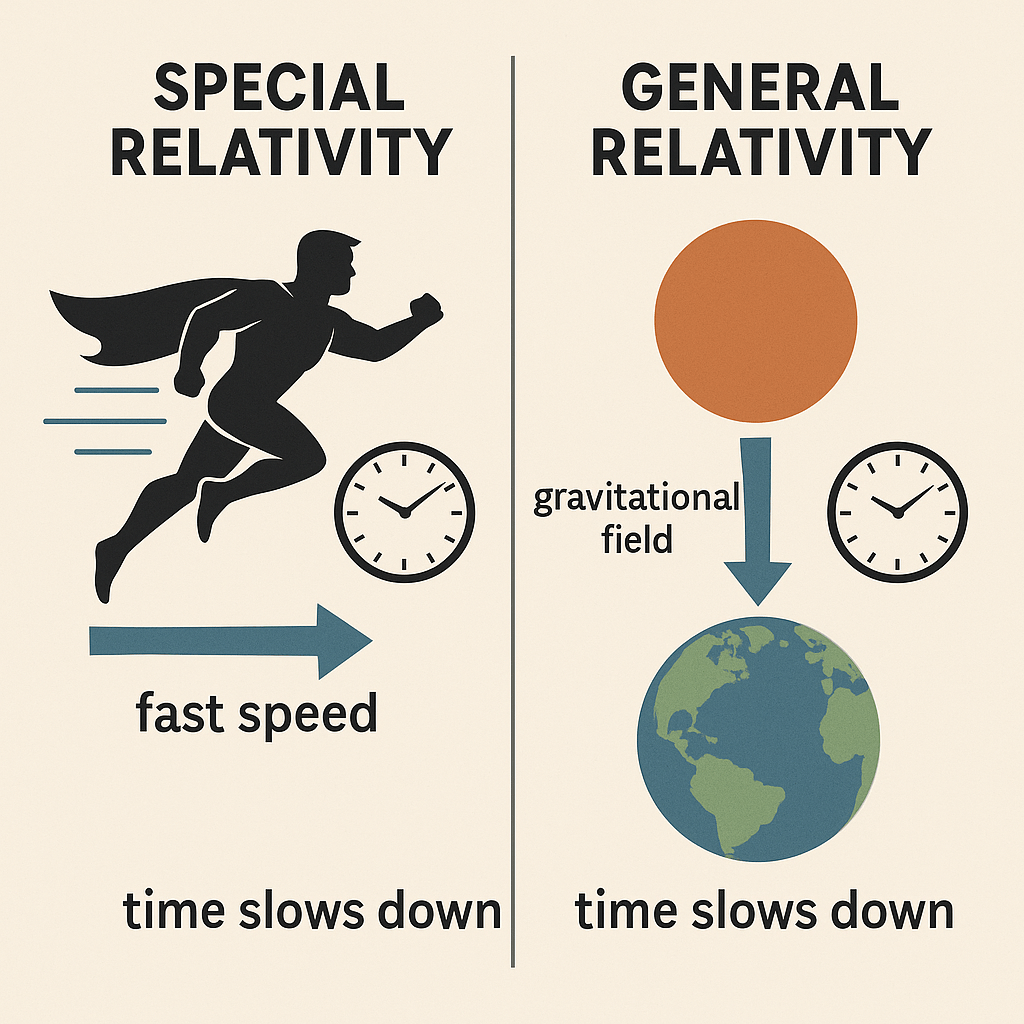
Time bends in two ways:
1. Speed slows time: Special Relativity (Einstein, 1905)
If you’re a superhero flying near the speed of light, time actually goes slower for you compared to non-superheroes. Your clock would show a different time compared to other people!
It was proven in 1971 when scientists flew atomic clock on fast-moving jets and compared it to identical clock on the ground. The flying clock ticked more slowly, just like Einstein had predicted.
2. Gravity slows time: General Relativity (Einstein, 1915)
Just pause for a second: a single human mind has discovered two of the biggest secrets of the universe!
Now the second way time bends. Einstein took the first theory further. In 1915, he added gravity and proposed general theory of relativity.
He discovered that if you’re standing at a lower altitude closer to the center of a massive object like Earth, time passes slower for you than someone standing higher up. This is because gravity is stronger the closer you are to the mass.
Carlo Rovelli puts it simply:
“Time for your head goes faster than time for your feet.”
And that’s not just theory. It was proven with atomic clocks placed at different heights even just a few centimeters apart. The clocks ticked at slightly different speeds.
Time isn’t some universal, fixed thing. It bends. It stretches. It depends on where you are and how fast you’re moving.
And the deeper we go into space, the more this becomes real and obvious. Probably real meaning of time makes more sense to the next generation.
 Mohsin With E
Leave a comment