Today I was thinking about the famous Mary’s Room thought experiment after listening to Alex O’Connor’s podcast, where he challenged a physicist to claim that philosophy is a real science. To illustrate his point, he referred to Mary’s Room thought experiment.
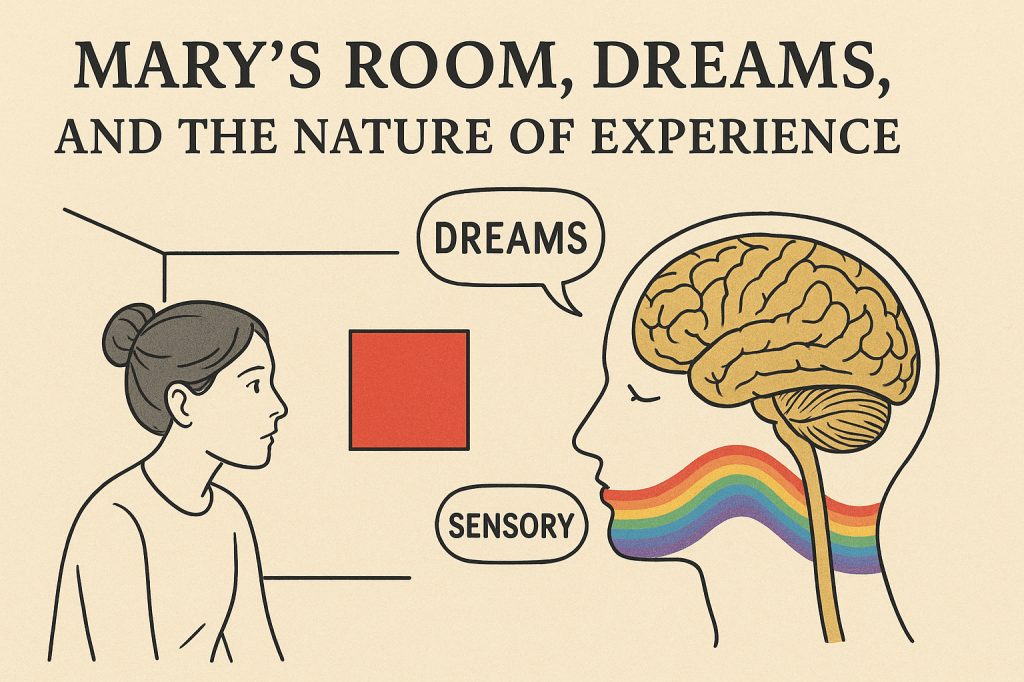
This experiment introduced by philosopher Frank Jackson in 1982: Mary is a brilliant scientist who knows everything about color vision from a physical and scientific perspective wavelengths, retinal responses and neural processing. However, she has lived her whole life in a black and white room and has never actually seen color. When Mary finally leaves the room and sees the color red for the first time, she learns something new and what it feels like to see red.
It suggests there’s a kind of knowledge called qualia, subjective experience which philosophers argue cannot be fully captured by science.
Then, physicist Sabine Hossenfelder offered a profound response. She argued that Mary’s new knowledge wasn’t mystical at all but it was simply the neurological activation triggered by the sensory input of seeing red. Until Mary’s brain actually experienced the neural firing pattern associated with perceiving red, that state of knowledge didn’t exist in her brain. Importantly, Hossenfelder noted that if Mary had been able to replicate or simulate those exact brain states inside the room (without light wavelengths actually hitting her eyes) she could in theory have “experienced” red without ever leaving. A compelling hypothesis.
That thought led me to consider our dreams.
During dreams, the brain is capable of generating vivid sensory simulations: sights, sounds, emotions that feel real while we are inside them. Neuroscientific research shows that the same regions of the brain that process waking perception (such as the visual cortex and limbic system) are active during dreaming. This means that the brain is actively constructing simulated sensory input that can be subjectively from lived experience.
If the brain processes dream generated sensory input in the same way it processes physical experiences, then dreams could serve as functional substitutes for real experiences. It is like you have been there.
This raises deep questions:
What is the difference between physical and dreamt experience?
What we call “experience” may not be real but be the brain entering certain patterns of activation, regardless of whether the trigger comes from photons, memories, or dreams.
 Mohsin With E
Leave a comment