This whole thought started with Peter Thiel’s idea of stagnation that real progress has slowed down. Thiel argues that AI is the only truly transformative invention of the 21st century.
I don’t agree.
And here’s why.
When I look back at the last thousand years, every century had at least one true invention. By true invention, I mean something that:
- was not imagined before
- was not forecasted before
- had no idea before
- was beyond human comprehension
Something that made people stop and say: “Wow, this shouldn’t be possible.”
You want example?
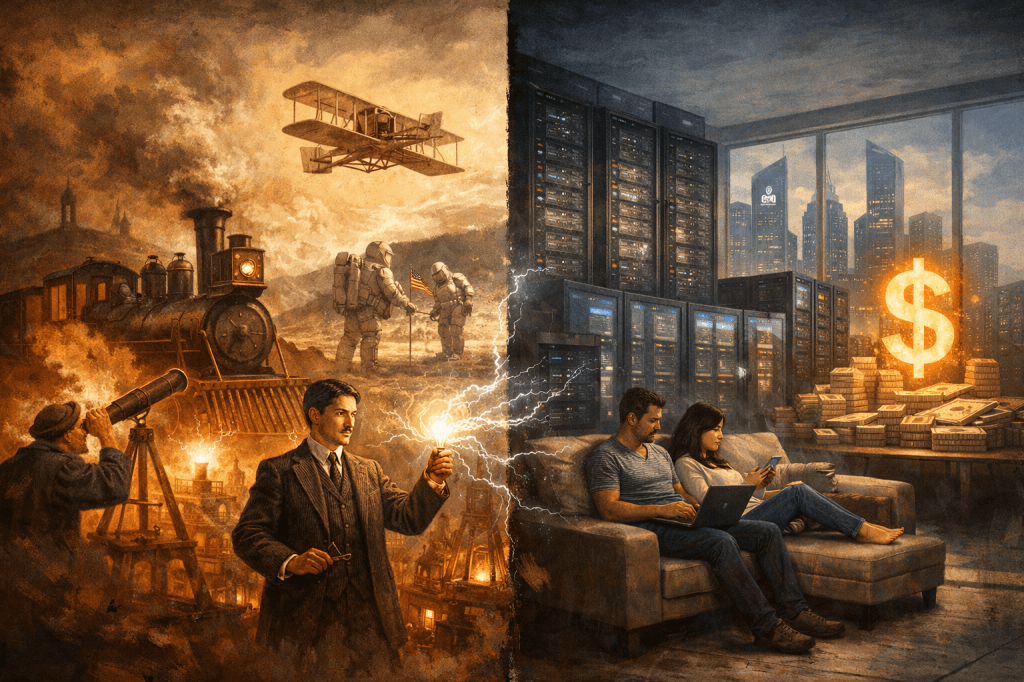
Consider Nikola Tesla’s public demonstration on May 20, 1891, at Columbia College in New York. He successfully transmitted electricity wirelessly, lighting lamps without any infrastructure or prior roadmap. He used newly invented alternating current electricity entirely on his own, without anyone else iterating towards this goal. This is a true invention.
Almost every century over the past 1000 years had something like this:
13th century: mechanical clocks 15th century: the printing press 17th century: the telescope 18th century: the steam engine 19th century: electricity 20th century: airplanes, nuclear energy, computers, and humans landing on the Moon on July 20, 1969.
There were also extreme attempts: early flying machines, artificial humans, mechanical life. They didn’t work, but they showed people were trying to break reality, not just optimize it.
Now look at the 21st century.
Something shifted.
We quietly replaced invention with innovation.
Quantum computing is a good example. People talk about it like it’s new, but the foundation goes back much earlier than Richard Feynman. Quantum mechanics started in 1900 with Max Planck, then exploded in the 1920s with Schrödinger, Heisenberg, and others. Feynman, in the 1980s, simply connected those ideas to computation.
AI is the same story. The roots go back to the 1950s , Alan Turing, John McCarthy, early neural networks. What we have now is scale: more data, more compute, better hardware. Powerful but not a new idea.
Even rockets. Reusable rockets are impressive, but the physics and core designs were worked out long ago. We are refining, not discovering.
Same with software. We use libraries written by others mostly long ago, stack frameworks on frameworks, and call it “new.” It works , makes money but not true invention.
This century isn’t short on intelligence.
It’s comfortable.
By 2025, we have 60 million millionaires, 3,000 billionaires and trillion-dollar companies. We also have enough food, energy and wealth although not distributed fairly. People constantly say “We already have enough” but that’s simply not true.
Why risk everything to invent something incomprehensible when optimizing existing systems still makes you rich?
That mindset is everywhere.
Now we’re openly hearing another idea: humans won’t need to contribute much anymore.
Who said?
Sam Altman has repeatedly talked about universal basic income as a future necessity in an AI-driven world.
Elon Musk has also publicly supported UBI and even suggested that AI-driven abundance could lead to a form of universal high income.
The message underneath is the same:
AI will do the work.
Humans will stay home.
Working and driving to innovate is optional.
That’s where it clearly feels like a decline.
A human ambition decline.
We didn’t stop inventing because we reached the end.
We stopped because we got comfortable.
 Mohsin With E
Leave a comment